memento mori ~ 2
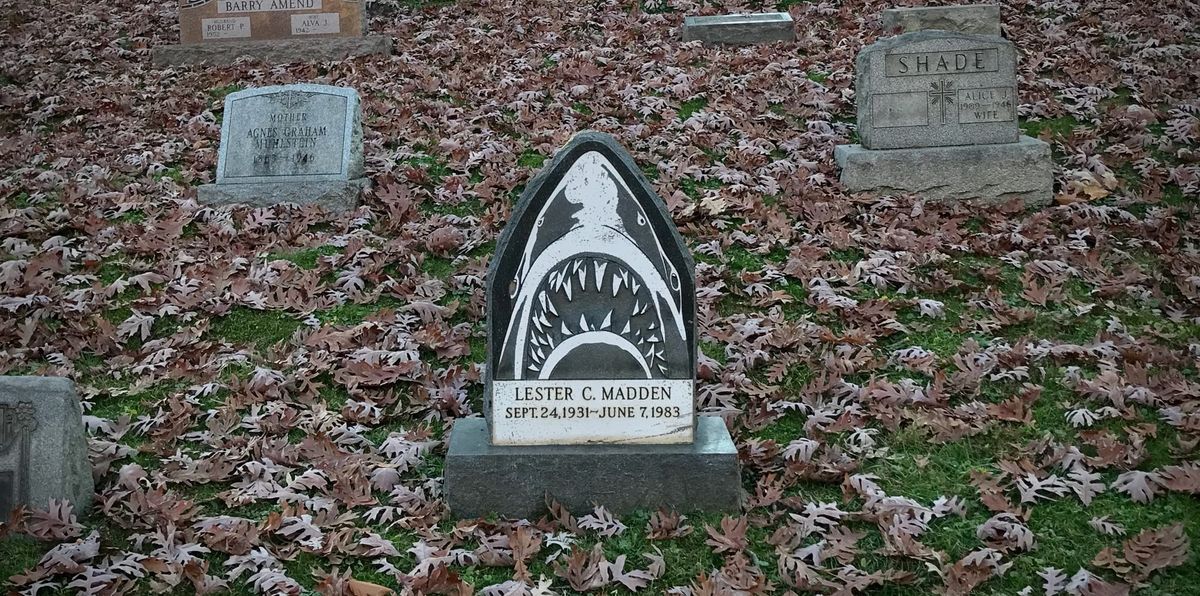
Leaning into the season – Halloween, All Saints' Day, All Souls' Day, Dia de los Muertes – I've decided to share a portion of something I've written on the subject of the cemeteries in an around Pittsburgh. It's the introduction to an essay series I'm calling Nine Cemeteries. I have been working on it for a few years. It's about visiting these places and the occupants therein. I set out on this adventure with the hope of spending time with some deceased family and friends, but also to stir up some stories from the past, especially some forgotten anecdotes about Pittsburgh. (Spoiler: It worked.)
So, without any additional ado, here's the introduction to Nine Stories, by me.
I know where the bodies are buried – some of them anyways. They are in burial grounds: burial mounds, churchyards, graveyards, cemeteries, and on private property. I spent years visiting these places and walking amongst the memorials, monuments, and tombstones without giving their existence, or death, a second thought. Outside of the writings of E. A. Poe, I’m not overly interested in the macabre. So, when I try to make sense of the hours I’ve spent within their boundaries, or seeking them out, it is difficult to parse out a clear reason.
As a child, my maternal grandparents, Audrey and Tom, lived butt up against a cemetery atop a hill in Hollidaysburg, Pennsylvania. My cousins and I would spend long summer days roaming the grounds, playing tag amid the plots and chatting in the covered pavilion, which is used as a service shelter during inclement weather because it fit both hearse and mourners. At dusk, we would play truth or dare as bats circled erratically overhead. Without fail, someone would be dared to peek into an overgrown single-family mausoleum as darkness descended on us. I was never the bravest of the bunch, but these experiences may help to explain why I equate burial grounds as places of joy and comfort.
These days I’m a writer. Well, I’ve written. I mean, I’m writing this, aren’t I? This career choice has peaks and valleys, which doom – or bless! – a person to long periods of searching for, and thinking about, what to write next. Stories can be found anywhere, but the most common place to find one is – surprise, surprise – a book. Writers must be avid readers, so I cherish the works of many long-dead American authors and writers. Their words often shatter the wedge time has driven between us. Those same words rattle around in my head, plant themselves in my core, and go to seed. In this way, I can feel closer to, and more understood by, these dead men and women than by anyone who ranks among the living. As a result, I have sought out the final resting place of many of them as a way to bear witness to a part of their journey: albeit the setting of their denouement. In these places, I’m struck every time I find remnants – trinkets or notes – left by pilgrims who have visited before me. The importance of locality, and of tangible things, rushes through me in these moments. It allows me to step out of the current of the modern world which coaxes us further into a more cerebral, divisive, and digital existence each day. I cling to the idea that there is an energy of place one can still connect with. Though I walk the grounds on a different calendar date, do I not follow the path of, and join, the funeral procession for the deceased? As I stand above what remains of the earthly husks of these individuals, I ponder how life may be no more than a continuation of existence, an accumulation of an increasing number of seemingly individual stories which add to the one true saga of the whole – to what each of us are but a mere part.
We are all born into a world that is crumbling and expanding at the same time. For much of my life, the cemetery behind my grandparents’ house was at capacity, filled boundary to boundary with crypts and mausoleums and tombstones that bore visual evidence of their years in the sun and rain and snow. Until it wasn’t. The caretakers created a fresh section by overtaking the nearby field where, as kids, my mother, her brothers, and their friends played baseball. With that, the cemetery started accepting new customers.
The more I visited cemeteries, the more I noticed links to the past, and plans for the future. Burial grounds became paradoxes, spaces where the past, present, and future intersected. It surrounded me every time I entered one, but it took time for me to become aware that I was treading on the surface of history. Indicators of the times offered themselves up if I just knew where to look. I could notice how death is a part of life and has been forever. Nathaniel Hawthorne, an American writer who spent countless hours considering graveyards, began his literary classic “The Scarlet Letter” by calling attention to society’s realistic need for, and foundation upon, such places:
The founders of a new colony, whatever Utopia of human virtue and happiness they might originally project, have invariably recognized it among their earliest practical necessities to allot a portion of the virgin soil as a cemetery, and another portion as the site of a prison. In accordance with this rule, it may safely be assumed that the forefathers of Boston had built the first prison-house, somewhere in the vicinity of Cornhill, almost as seasonably as they marked out the first burial-ground, on Isaac Johnson’s lot, and round about his grave, which subsequently became the nucleus of all the congregated sepulchres in the old church-yard of King’s Chapel.
What’s most wild is that – beyond this being historic facts plopped into the pages of a novel – all burial grounds begin as a conscience decision made by humans and, as time powers forward, these grounds evolve as well. A rough boulder marks the spot in the cemetery behind my grandparents’ where the first Presbyterian church of the region was built using unhewn logs in 1788. During the late-colonial period, family plots were giving way to churchyards as the preferred location of burials. So now I know, the cemetery I stood in had once been a churchyard. The “rural” or “garden” cemetery movement, which was new in the decade after the Civil War, morphed the grounds under my feet into the landscaped park of sorts I visit to this day. The shift in trends of burial styles also reveals Americans’ changing attitudes towards death: gone were words like “coffin” and “graveyard.” Installed in their place were the words “casket” and “cemetery,” which in Greek means “sleeping place.” Much less grisly to modern sensibilities. The epitaphs and symbols changed over time as well. I recall seeing a death’s head on a tombstone in a cemetery in Salem where Hawthorne once walked. The 17th-century Puritan symbol spoke to me so clearly – it highlights how the physical and spiritual world are intimately entwined – that I had the image digitized and embroidered on a fitted baseball hat. All of which is to say that though these places are of the past, we can still experience them in the present, and we do carry them with us into the future, mostly figuratively as episodes of our existence, but sometimes quite literally as when we leave with a souvenir.
Despite how it may seem, my visits were not organized. They weren’t even well-planned. Without a strategy, only about half of my trips were fruitful. I tracked down Stephen Crane in New Jersey, my confused friend and her newborn in tow. But finding Muhammad Ali’s grave outside of Louisville didn’t pan out. I’d get where I was traveling and then think, “Who might be nearby?” It did not always work out. Still, my list – not that I kept a list before sitting down to write this – grew over the years. Some stops were memorable: a Baltimore man shouting – “Is that you family?” – through the wrought-iron fence as I contemplated the typo on Edgar Allan Poe’s memorial. Locating August Wilson after spending a day at his childhood home in the Hill and at his center in downtown Pittsburgh took longer than the other two stops combined. Section 7 of the Greenwood Cemetery on Sharp’s Hill did not fall in logical order, so after hours of walking the grounds, I discovered that he rests on a hillside as far from the entrance as possible. The reward came as dusk closed in — his epitaph reads:
“WHEREVER YOU ARE
YOU ARE
I’M HERE”
A joke? A concession? An acceptance of a neighbor? Knowing his works, likely all of the above. By chance, I discovered that two worthwhile cemeteries bear the name, Sleepy Hollow Cemetery, despite being in different states, New York and Massachusetts. Washington Irving’s remains can be found in the first, interred on the grounds that serve as the setting of his legend. The latter, which is in Massachusetts, is home to Artists’ Ridge, where Louisa May Alcott, Nathaniel Hawthorne, Henry David Thoreau, and Ralph Waldo Emerson all wait out eternity. That visit alone grows the list. In Philadelphia, tours snake through Christ Church Burial Ground – one of the few that charge an entry fee – to see the graves of Benjamin Franklin and a few other signers of the Declaration of Independence. However, I want to extend a big thank you to the historian who fought for the plaque which calls attention to the burial site of John Taylor (1718-1803), who was the gravedigger for each body under soil on those grounds save his own. Those who make this all possible through their grunt work rarely get that type of recognition. As my list grew, I became aware of, and joined the ranks of, those who leave trinkets or notes. I typically leave one handwritten haiku under a previously left trinket. My haiku to Melville, which I left at Woodlawn Cemetery in the Bronx during the early months of the Covid-19 pandemic, reads:
Look alive, Herman
Things haven’t gotten better
We need more words now!
At Stephen Crane’s grave – my first! – I hadn’t started this habit yet, but other visitors had left coins, swatches of red fabric, pens and pencils, and even little green army men. I was unfamiliar with this custom at the time and still don’t quite understand the compulsion. The notes give off similar vibes to a trail book or guest book. It is fun when you find them and can look back to see what others have written. What’s weird about the detritus left grave side is I invariably think about grave goods: keepsakes and talismans sealed inside the casket with the deceased and buried. Jewelry, photographs, sports memorabilia, and religious items are the most common, but I’ve been told of odder artifacts, sometimes unexpected ones. My uncle, a funeral director – what did you expect growing up next to a cemetery – recently shared that the granddaughter of a comedic old man placed Groucho Marx glasses – of the eyebrows, nose, and mustache variety – on his face at his viewing and the family just let it roll. I can only imagine the look on a grave robber’s face if he popped the lid of that one. I know that many of these items are removed and returned to the family before the final curtain, but just as many are along for the ride. While I dwell on what remains underground with the remains, I can’t help but remember something once told to me. A new problem, one unique to our time: materials used to repair, replace, or enhance human body parts will far outlast flesh and bone in the casket. Years after the burial, I imagine a hip joint detaching and landing with a thud, or a breast implant sliding free and rolling end over end, like a slinky, until it settles into a pillowy fold of the casket bedding. Whether it’s a trinket, a note, or an implant, each of us give in to, or fight, the desire to leave traces of ourselves wherever we go. It’s why people carve their initials into trees, why they post things on social media, and why they have children. Is it not? That same instinct is why we have tombstones in the first place. Sure, it gives the living a physical location to grieve, but they are also a billboard proving to others that we existed. And they work. The names I mutter as I read them on stones and monuments keeps the memory of that person alive just a bit longer, even if I didn’t know them personally. And isn’t that what we all want?
Instead of fumbling through more cemetery visits as the spirit moved me, I decided to get serious in November of 2022. We had just received word that the live-action, coming-of-age television series I had been working on would not be renewed for a second season and I was looking for something to write – i.e. do. Each year on the Day of the Dead, or All Soul’s Day if you prefer, I visit a burial ground. Most often I go see my paternal grandparents south of the city of Pittsburgh. Since so many cemetery visits successfully spark creative juices, I figured I’d pick and tour a different burial ground for nine straight days. I mean, who doesn’t like a good novena? Especially as a literary framing mechanism. To be honest, I was trying to scare up some stories. And if I’m being really honest, it worked. I came out of the experience with a treasure trove: details about Pittsburgh’s history and its weird characters, family secrets I never knew about, and long forgotten memories that returned suddenly to the surface. Who’s the grave robber now? But it’s not like I’m the first to go about it this way. I’m not even the most honest about it. Hawthorne ends “The Scarlet Letter” with a reference to the real-life symbol he saw on a grave during one of his outings. That symbol became the basis for his much-loved novel. He wrote:
And, after many, many years, a new grave was delved, near an old and sunken one, in that burial-ground beside which King’s Chapel has since been built. It was near that old and sunken grave, yet with a space between, as if the dust of the two sleepers had no right to mingle. Yet one tombstone served for both. All around there were monuments carved with armorial bearings; and on this simple slab of slate—as curious investigator may still discern, and perplex himself with the purport—there appeared the semblance of an engraved escutcheon. It bore a device, a herald’s wording of which might serve for a motto and brief description of our now concluded legend; so sombre is it, and relieved only by one ever-glowing point of light gloomier than the shadow:–
“On a field, sable, the letter A, gules.”
With that ending, we begin. I’m more than happy to carry the mantle Hawthorne once bore, of being the curious investigator perplexed with the purport of a few escutcheons I’ve discovered on my ventures. So now, at the final resting place, we start.
indoor animal is curated by a human: Tim Papciak. On Mondays, he shares one link to one music video to help spark creativity in himself and in other creative types. On Thursdays, he recommends a book, movie, show, art piece, or link to some dusty corner of the internet that he believes either 1.) adds to the human experience, or 2.) serves as a coping mechanism in the year 2025. Note: this is not, and never will be, self-help content.