show me a hero

It's mid-December and the Allegheny River already has ice on it pretty much from bank to bank so let's just say I'm not in the best of moods. I can stomach winter, and can even enjoy it, but it came in a bit too hot and heavy for me this year. Then, this writer I sometimes read dropped a short opinion piece about their love for the antihero. That, I can't stomach. Not right now at least.
I soured on the antihero archetype quickly. I skipped most of The Sopranos because I didn't care what Tony and his pals were up to. I watched the last season in the hopes that he'd have to reckon with his actions, his morals, his soul. He kind of did, but really didn't. Two seasons into Breaking Bad and I was actively rooting against Walter White. When he was given a semi-heroic ending, instead of being left to fester with the knowledge of his villainous, cruel choices, I remember being annoyed for weeks. He should have to live with the monster he became.
The problem: the antihero became mainstream and television show after television show embraced that character as its lead, as its guiding light. Audiences were, and still are, seduced by antiheroes. Another problem: garbage in, garbage out. As they say. What we watch and who we root for in the fictitious world of television and movies no doubt influences what we allow, condone, or excuse out here in the real world. Moral fatigue is real. Antiheroes permit us to try a little less hard. If the "good guys" aren't trying all that hard to follow a moral compass, none of us need try all that hard either – as long as the ends are, or seem, just.
Another problem: true heroes, as we would have previously defined them, now seem suspicious and a bit naive by comparison. And many folks root against any of these shining stars, these white knights, because if those people are real, we have to feel pretty bad about ourselves.
Then came The Leftovers, a show I love. It had an antihero at its heart, but over the course of three seasons, it dragged that character through mud and guts kicking and screaming until they reckoned with who they were deep down and what they've done. Bravo. I had hoped that this would be the beginning of the end of the antihero, but shows have since devolved even further and now we're getting true crime shows told from the point-of-view of serial killers. When we spend hours watching these people, we may become sympathetic to them, we may start to justify this action or that one, and, worst of all, we even begin to understand them.
Around the same time as The Leftovers, a miniseries called Show Me a Hero came out as well. It is an adaption of a nonfiction novel of the same name.
Show Me a Hero (Created by: David Simon, Dir. Paul Haggis)

Both are fantastic, and the Nick Wasicsko character – which the show focuses on more closely than the book – was an actual, real-life hero of sorts. Instead of an antihero at its heart, he was a hero with handcuffs. He confronts the personal cost of doing the right thing when no one else wants it. Instead of the ends justifying the means, he was doing what he believed, what he thought was right, and in the end, we all knew what was going to happen to him, what always happens to people who try to do what is right in the real world: tragedy. Hence the title of the book and the show, Show Me a Hero, which is a portion of the real quote from F. Scott Fitzgerald:
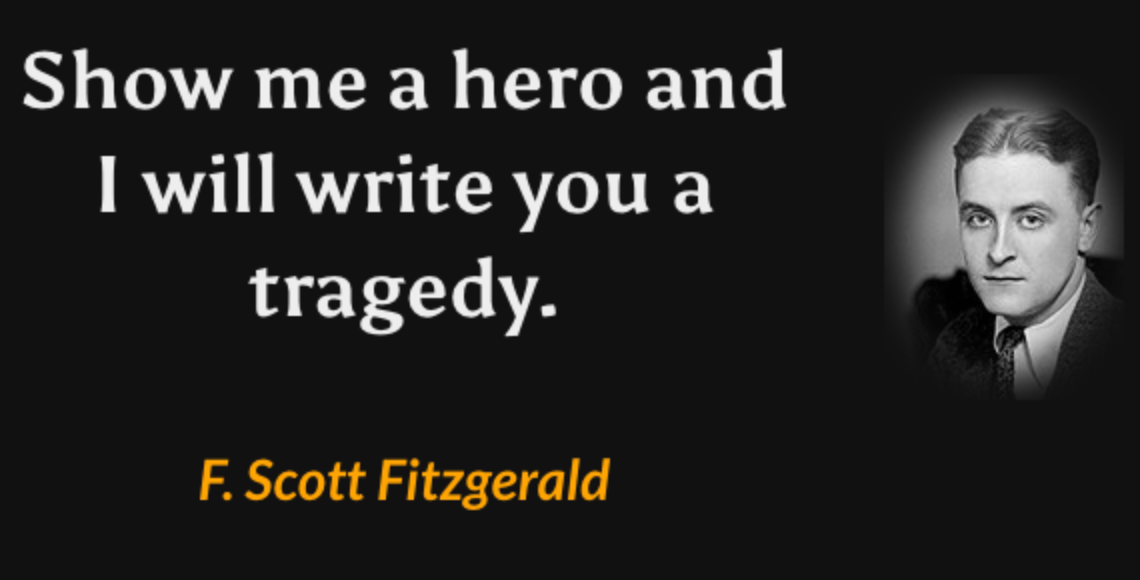
The quote comes from (simplifying a bit here) a posthumous collection of essays from F. Scott called The Crack-Up. The titular essay was original published in Esquire way back in 1936, when he was 39-going-on-40. It's not easy to describe as it is a first-person account of an individual reckoning with a transition in life that presents itself as a breakdown of body, mind, and nerves.
And there's no simple quote or section to pull for my purposes here to showcase the central theme of it. So here's a snippet of it to get its tone, its vibe:
I realized that in those two years, in order to preserve something—an inner hush maybe, maybe not—I had weaned myself from all the things I used to love—that every act of life from the morning toothbrush to the friend at dinner had become an effort. I saw that for a long time I had not liked people and things, but only followed the rickety old pretense of liking. I saw that even my love for those closest to me had become only an attempt to love, that my casual relations—with an editor, a tobacco seller, the child of a friend, were only what I remembered I should do, from other days. All in the same month I became bitter about such things as the sound of the radio, the advertisements in the magazines, the screech of tracks, the dead silence of the country —contemptuous at human softness, immediately (if secretively) quarrelsome toward hardness—hating the night when I couldn't sleep and hating the day because it went toward night.
Wait... Am I cracking-up myself?! Ranting about an archetype in modern television out loud, in public, sure fits the definition he lays out. I do feel bitter about all of this. I also struggle to sleep at times. Thing is, this "crack-up" as Fitzgerald describes it, happens to us all. But it's rarely shown on television. That's because I think it is too Real. Walter White gets off easy in the end. Nick Wasicsko doesn't. I'm a better person for watching the narrative drama unfold in Nick's story. Walter's, not so much. So, I continue to wait for the streamers, for Hollywood, for anyone and anything to SHOW ME A HERO! Seriously, we need it now more than ever. (Even Vince Gilligan, creator of Breaking Bad, has said as much recently.)
indoor animal is curated by a human: Tim Papciak. On Mondays, he shares one link to one music video to help spark creativity in himself and in other creative types. On Thursdays, he recommends a book, movie, show, art piece, or link to some dusty corner of the internet that he believes either 1.) adds to the human experience, or 2.) serves as a coping mechanism in the year 2025. Note: this is not, and never will be, self-help content.